You’ve probably heard of Golden Data. But what about Golden Context?
One definition I came across stuck with me:
“Golden Context is the smallest set of information that makes the correct answer almost inevitable.” — Nexumo, Medium (Dec 2025)
That definition is about the context window: what to put in front of a model for a given question. It’s a great principle but it got me thinking about Golden Context from a broader angle: as an enterprise knowledge management concept.
Here’s my broader definition:
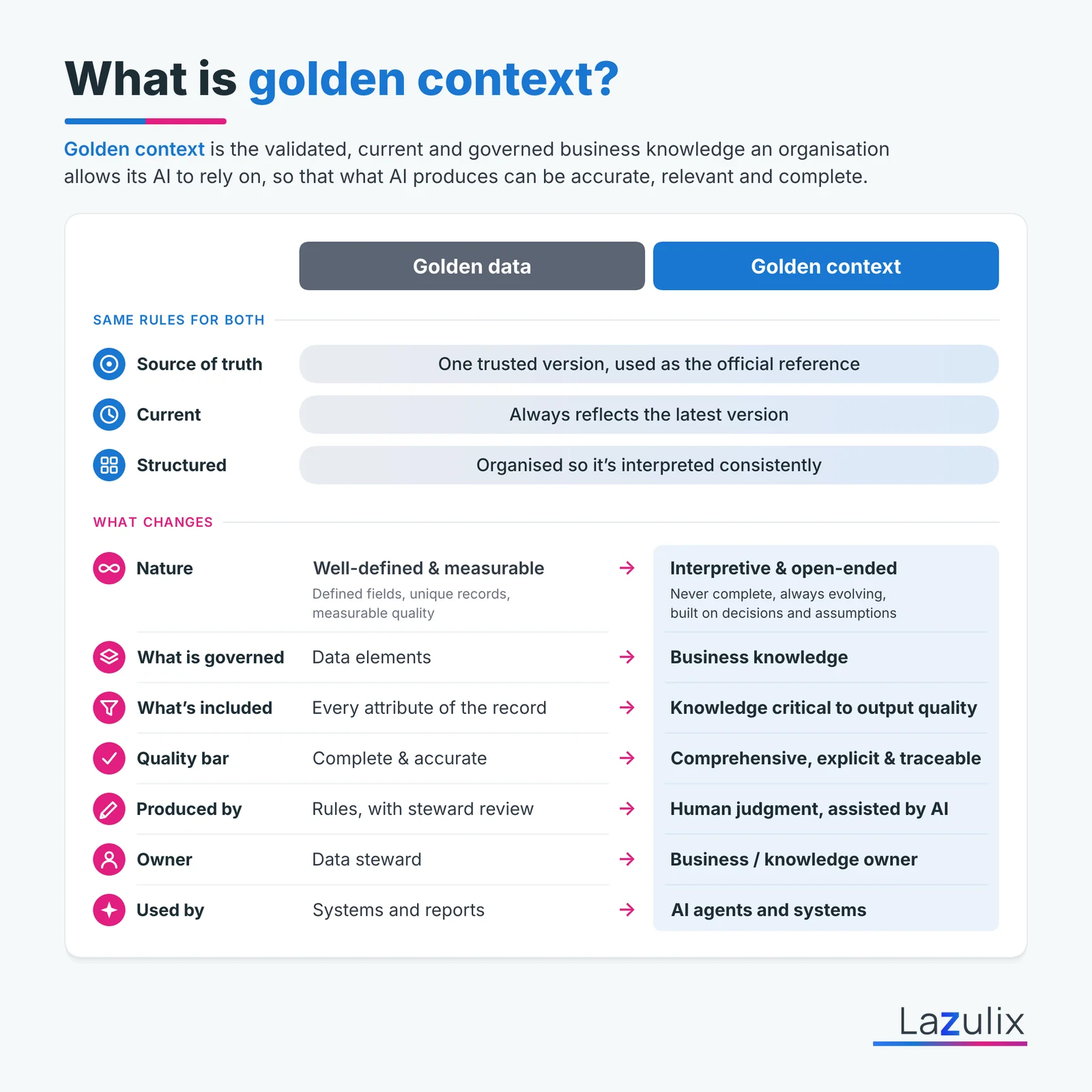
Golden Context is the validated, current and governed business knowledge an organisation allows its AI to rely on, so that what AI produces can be accurate, relevant and complete.
Golden Data is the trusted reference for business records.
Golden Context is the trusted reference for business knowledge.
Context engineering determines what AI actually receives for each task.
Golden Context is much harder to pin down than golden data:
↳ Golden Data is well-defined: a known structure, measurable quality, clear rules for what’s correct.
↳ Golden Context is open-ended: never complete, always evolving, and its value depends on the task.
An AI's context window typically holds more than just business knowledge: system instructions, conversation history, available tools and skills, and the data the AI is given or retrieves itself.
Golden Context is only one ingredient, but in my view it’s the hardest to get right and the one that will set organisations apart.
AI labs keep improving the models and their general capabilities. What they can’t supply is what’s specific to your organisation: its decisions, commitments, operating principles and experience.
Why not just feed the entire knowledge base and all the meeting transcripts?
🔹 Context pollution: wrong or outdated information steers the answer.
🔹 Context dilution: the signal gets buried in noise.
🔹 Context rot: models can become less reliable as input grows, even on simple tasks
More context isn’t better. The right context is. That’s why Golden Context has to be rigorously maintained: current, relevant and free of clutter.
Here’s what I firmly believe: because Golden Context is open-ended, deciding what belongs in it takes human judgment.
People know what matters, what was decided and why, and what never made it into a document. And having a person accountable for it is what keeps it governed (more on that in my next post).
➡️ As models get better, the payoff for getting context right only grows.
The challenge isn’t just documenting what an organisation knows. It’s making that knowledge explicit, trustworthy and usable by AI, even when the people who hold it aren’t in the room.
Thoughts?